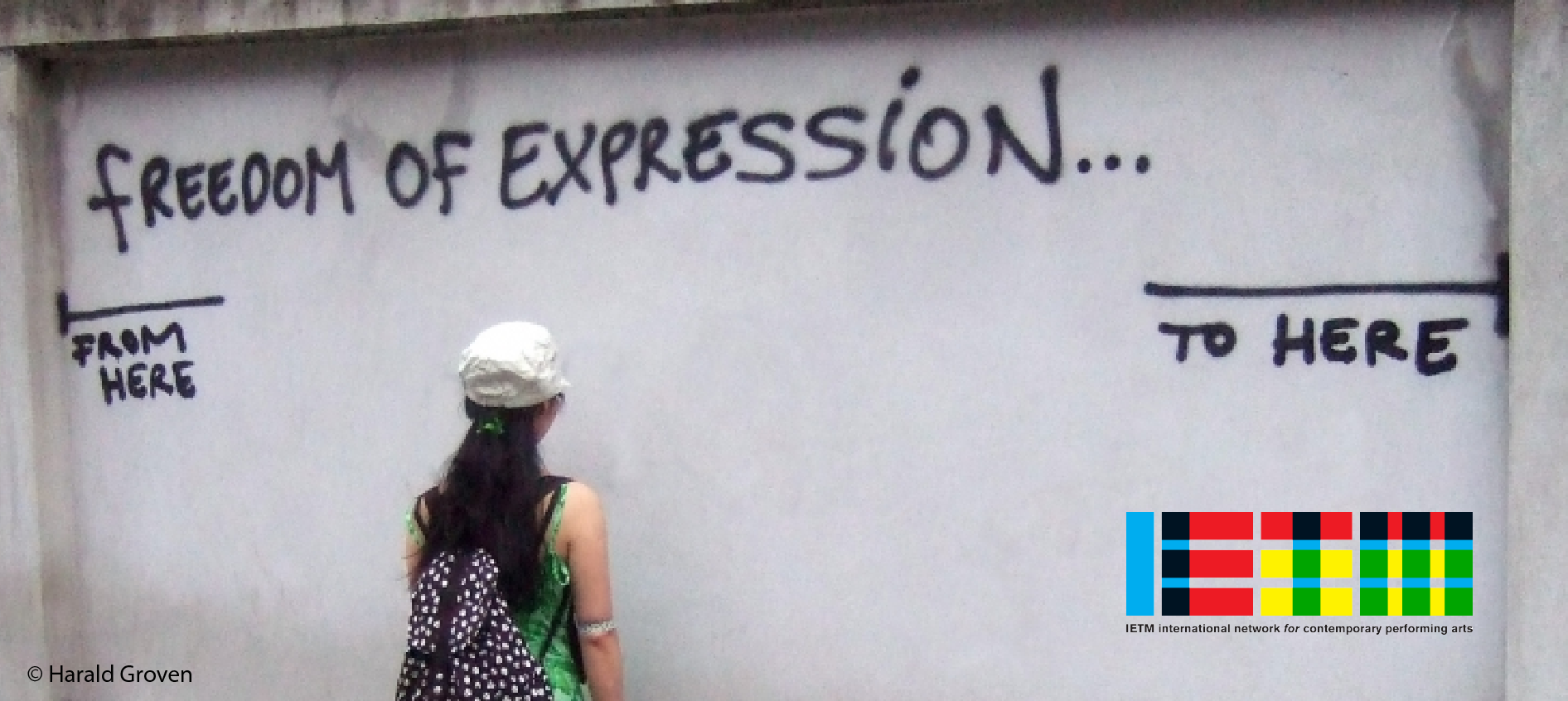



IETM, in partnership with Arts Everywhere launched a call for contributions for the upcoming publication "Fresh Perspectives on Freedom of Expression and Censorship". Deadline has been set on 31 January 2018.
IETM Call for contributions
IETM, in partnership with Arts Everywhere launched a call for contributions for the upcoming publication "Fresh Perspectives on Freedom of Expression and Censorship". Deadline has been set on 31 January 2018.
The University of Aarhus invites all interested participants to submit the Paper for the Cultures of Participation 2018 conference which will take place from 18 to 20 April 2018 at Aarhus University (Aarhus, Denmark).
The objective of the International Award 'UCLG – MEXICO CITY – Culture 21' is, to recognise leading cities and individuals that have distinguished themselves through their contribution to culture as a key dimension in sustainable cities.
The International Award 'UCLG – MEXICO CITY – Culture 21' has two categories: the City / Local or Regional Government Award, which recognises a city, local or regional government the cultural policy of which has contributed significantly to linking the values of culture (heritage, diversity, creativity and transmission of knowledge) with democratic governance, citizen participation and sustainable development, and the Individual Award, which recognises an internationally renowned individual who has made a fundamental contribution to the relationship between culture and sustainable development.
The Rules of the International Award 'UCLG – MEXICO CITY – Culture 21' are available in English, French, Spanish, and Russian.
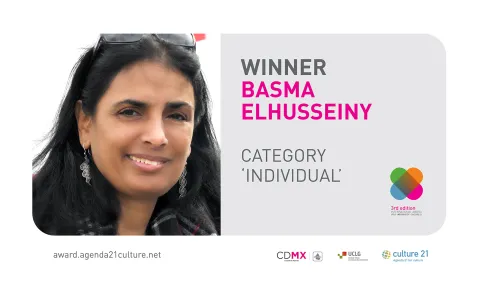
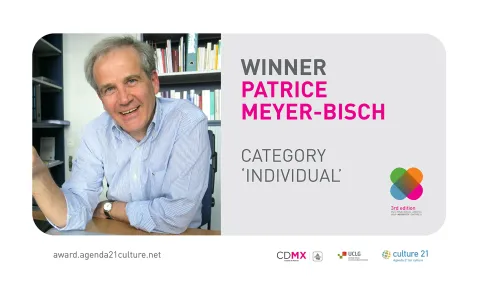
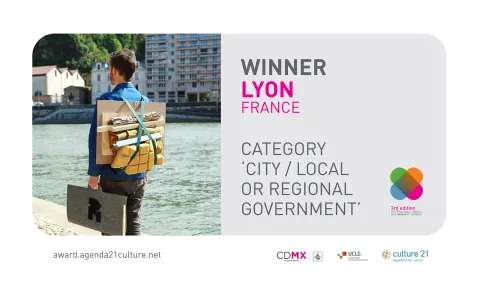
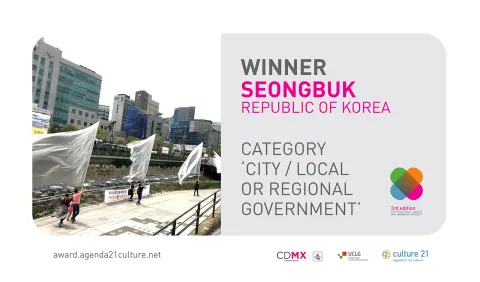
WINNERS: Lyon and Seongbuk as Cities and Basma ElHusseiny and Patrice Meyer-Bisch as Individuals.
On Friday 25 May 2018, during the UCLG Executive Bureau in Strasbourg (France) the winners on the 3 rd edition of the International Award UCLG - Mexico City - Culture 21 were announced by the Mexico City. Check out more on the winners in both categories, as well as the special mentions accorded by the Jury.
The final report of the Jury of the 3rd edition is now available.
The Award Ceremony will take place on 18-20 October 2018 in Mexico City. This event will also be the occasion to organise an International Seminar on 'Cultural Rights in the City', and to celebrate the 15th annual meeting of UCLG Committee on Culture.
The abstracts of the 99 applications received have been gathered in the document aside, and can be separately downloaded from this map.
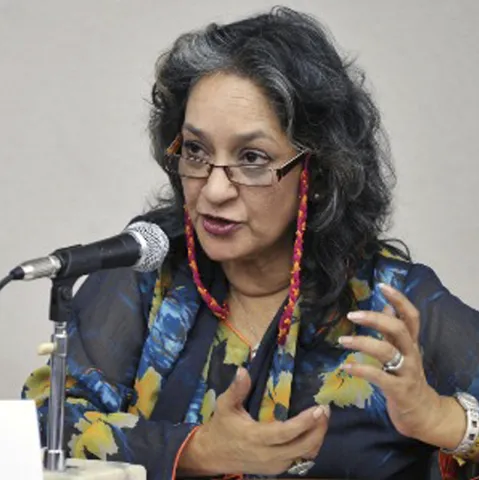
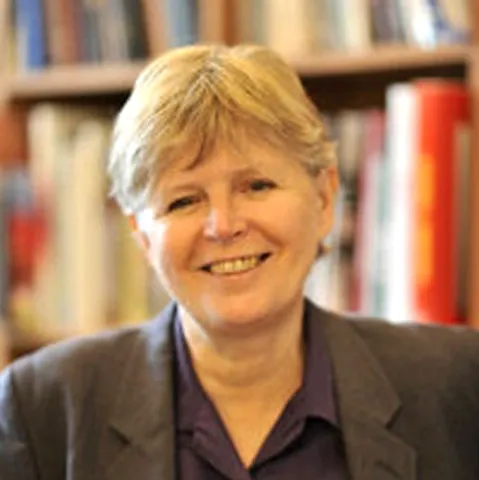
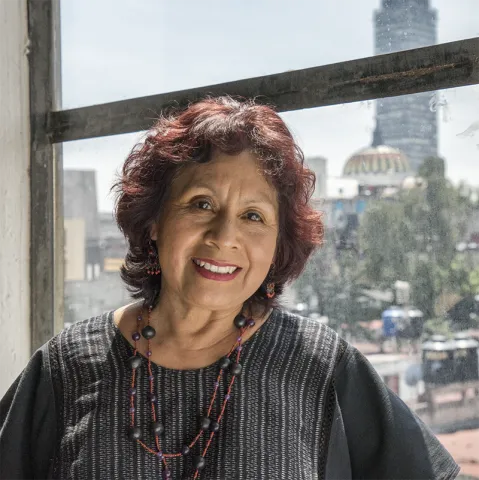
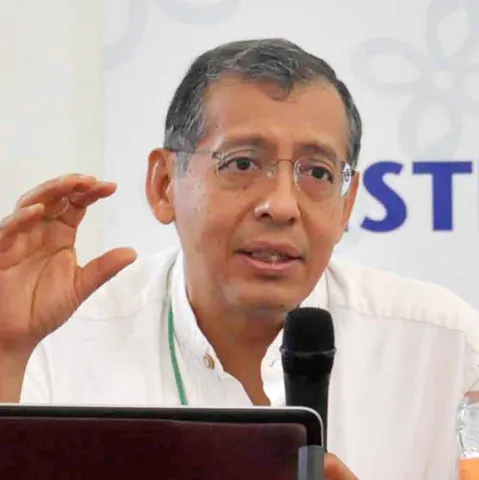
The Jury of the 3rd edition of the International Award UCLG - Mexico City - Culture 21 was made up of the following five members, all of whom are prestigious international experts with impeccable trajectories in the cultural field: Farida Shaheed (president of the Jury); Catherine Cullen; Lucina Jiménez; Eduardo Nivón and Eduardo Vázquez Martín.
See below the document of presentation of the International Jury of the 3rd edition of the Award.
The Call for candidacies to the 3rd edition of the International Award UCLG
- Mexico City - Culture 21 was open from 2 November 2017 to 16 March 2018.
The Call is now closed.
All candidacies will be carefully examined by the International Jury of the
Award.
The winners will be announced in May 2018.
The Rules are available here.
The Call for nominations of the 3rd edition of the International Award UCLG - Mexico City - Culture 21 was open from 2 November 2017 to 16 March 2018.
The Call is now closed.
All nominations will be carefully examined by the International Jury of the Award.
The winners will be announced in May 2018.
Cultural manager and activist. Basma El Husseiny is now leading the organisation Action for Hope, based in Beirut, that seeks to provide cultural relief and cultural development programmes to communities in crisis, with a focus on refugees and impoverished communities. She has been involved in supporting independent cultural projects and organizations in the Arab region for the past 30 years.
Basma was the Arts Manager of the British Council in Egypt (1988-1998) and the Media, Arts & Culture Program Officer for the Ford Foundation in the Middle East and North Africa (1999-2003). In 2004 she founded Cultural Resource – Al Mawred Al Thagafy, the Arab region’s leading independent cultural organization, and was its director until September 2014. In 2006 she also co-founded the Arab Fund for Arts & Culture (AFAC), and was a founding trustee until 2009. She also co-designed the Master’s Degree in Cultural Policy and Cultural Management at the Hassan II University in Morocco.
Basma is a UNESCO expert in cultural governance, member of the Arab Cultural Policy Group, previous member of the Advisory Board of the Center for Cultural Policy and Management, at the Bilgi University in Istanbul and the Egypt representative of the Arterial Network (Africa’s largest cultural network).
He holds a PhD in Philosophy from the University of Fribourg, Switzerland, and completed a professorial thesis on Political Ethics at the University of Strasbourg, France. Until 2016, he coordinated the Interdisciplinary Institute of Ethics and Human Rights (IIEDH) at the University of Fribourg, and he currently chairs the Observatory on Diversity and Cultural Rights (an IIEDH programme established in 2004) and the UNESCO Chair in Human Rights and Democracy, at the same university.
He is well-known for his work in the field of cultural rights at an international scale, as the main promoter of the Fribourg Declaration on Cultural Rights (2007), the result of 20 years of work by an international group of experts, known as ‘the Fribourg Group’, which fosters cultural rights within the human rights system. Patrice Meyer-Bisch has conducted research in several European and African countries.
He has significantly influenced the understanding of cultural diversity and cultural rights as ways to achieve inclusive sustainable development for everyone and in all areas, through the effective implementation of the interdependency of human rights. In the context of these activities, cultural rights are understood, alongside economic rights as well as civil, political and social rights, as the basis, the ‘grammar’, the space for interpretation, for the development of all individuals and societies.
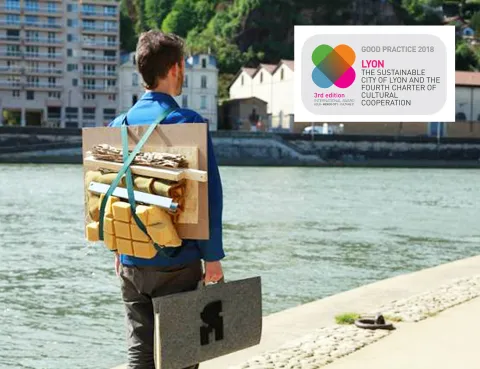
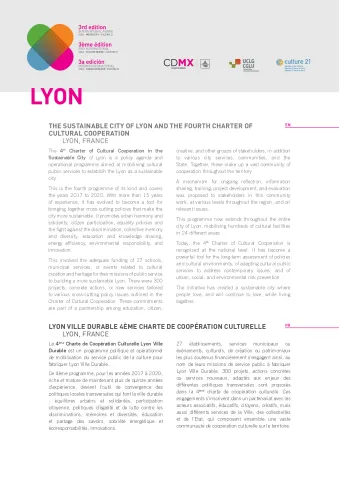
The Charter of Cultural Cooperation has been implemented for over 15 years in Lyon, involving 27 municipal services, cultural projects and events, including those that receive the most funding from the city, which altogether carry out over 300 projects, actions and services adapted to the challenges of policies that connect culture and sustainable development across the city. Now in its fourth edition, Lyon’s Charter of Cultural Cooperation now extends throughout the entire metropolis of Lyon, including 24 municipalities.
The programme has become a powerful tool for cultural policy. The Charter promotes the convergence of cultural policies, in specific commitments, with each of the transversal local policies that contribute to ‘making’ a sustainable city: urban balance and solidarity, citizen participation, policies for equality and non-discrimination, memories and diversities, education and knowledge exchange, energy efficiency, environmental responsibility and social innovation.
Furthermore, the programme involves a continuous process of shared reflection, information exchange, capacity-building, project design and evaluation with all stakeholders involved, at different territorial levels and on a range of regularly-evolving themes.
Check out the video elaborated by the City of Lyon in the context of the 3rd edition of the International Award UCLG - Mexico City - Culture 21.
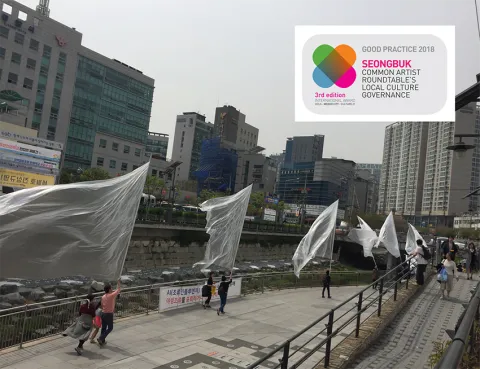
The programme “Common Seongbuk Artist Roundtable: Local Culture Governance” began in 2014 in Seongbuk, a district of Seoul, and has become the most important community initiative in this area, involving over 300 people working together on the basis of cultural governance.
The Artist Roundtable defines itself as a network that works together for the coexistence and cooperation of the local culture. One of its objectives is the cooperative work with those responsible for the cultural policy of the city, through the Seongbuk Cultural Foundation and with the other public institutions with responsibility in the city.
The Artist Roundtable operates on the values and principles of ‘autonomous activity’ (autonomy), ‘cultural democracy’ (democracy), ‘friendship and cooperation’ (solidarity) and ‘respecting cultural differences’ (diversity). Furthermore, the initiative organises local festivals, manages cultural venues and contributes to supporting the artistic and cultural community in the area.
Dublin (Ireland)
For the programme “Culture Connects”, established in 2015. This initiative is based on people’s stories, wishes and experiences. This is a very solid, innovative programme that contributes to cultural empowerment and which has shown the importance of listening, learning and sharing with local inhabitants. It also proves that, where willingness exists, cultural policies can be useful to those who most need them.
Hamilton (Ontario, Canada)
For the programme “’Love Your City’: Transforming Hamilton through Culture’, based on the consideration of culture as the fourth pillar of sustainable development. The programme has taken the form of a Cultural Plan, with a holistic and integrative approach to planning, which involves the community using a variety of engagement techniques, resulting in a ‘shared responsibility for culture’.
Montevideo (Uruguay)
For the programme “Cultural Policies with a Perspective on Gender Equality”, which has been shaped after in-depth discussions with the cultural actors in receipt of public funding and has led to very specific programmes and projects in the field. Its impact proves that, where political will and operational rigour exist, mainstreaming a gender perspective in cultural policy contributes to broadening freedoms for everyone.
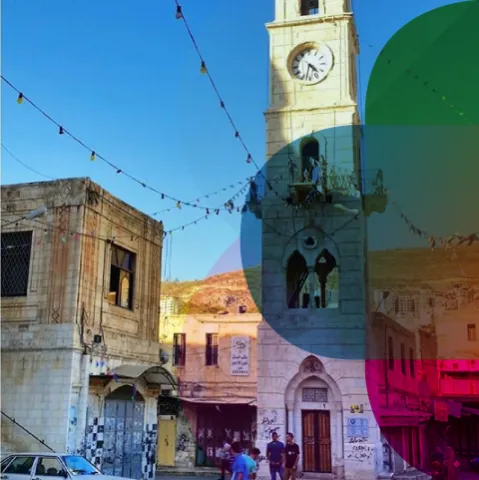
Nablus (Palestine)
For the programme “Saving Cultural Identity under Occupation – Regeneration of Nablus Historic Centre”, due to the commitment of local educational, civil and municipal institutions towards the regeneration of the historic centre, in order to enable local inhabitants to remain in their homes and ensure the rebuilding of hundreds of heritage buildings and houses.
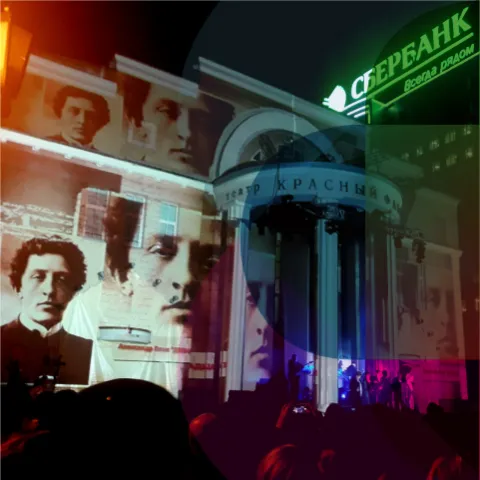
Novosibirsk (Russian Federation)
For the project “Novosibirsk: Turning the City into a Museum”, which promotes cultural and artistic activities in the city’s public spaces, the uses of information technologies and citizen involvement in specific activities.
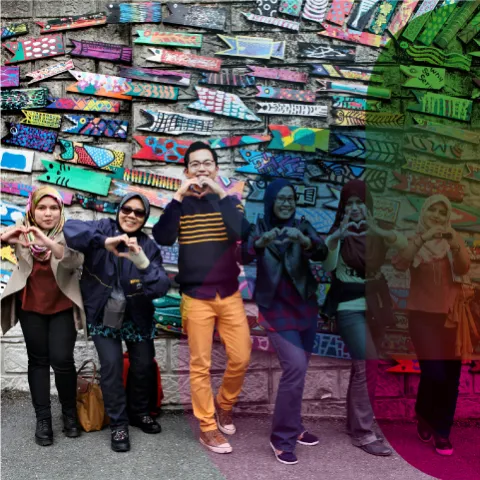
Saha-gu (Busan, Republic of Korea)
For the project “Gamcheon Culture Village Project”, a multiannual urban regeneration initiative through the arts and culture, which has contributed to revitalising the Gamcheon village. The project has involved close cooperation among residents, artists and the local government, in an innovative system of democratic governance.
Mrs Karima Bennoune, UN Special Rapporteur in the field of Cultural Rights will present her last report on "The Impact of Fundamentalism and Extremism on the Cultural Rights of Women: Time to Take a Stand." on next 26 October (5-7 pm) during a side event of the UN General Assembly (UN Headquarters, New York).
Финансовый рынок постоянно развивается. Старые компании уходят, новые — появляются и предлагают выгодные условия, чтобы привлечь клиентов. Важно следить за актуальными предложениями, особенно если нужен первый заём или лояльный подход. Обратите внимание на https://kreditstore.com.ua/novye-mfo-ukrainy/, где собраны свежие участники рынка. Эти организации часто предоставляют кредит под 0%, упрощённую верификацию и высокую вероятность одобрения. Благодаря этому можно получить деньги в день обращения без отказа. Особенно актуально это для тех, кому отказали в других местах или кто ищет более выгодные условия.
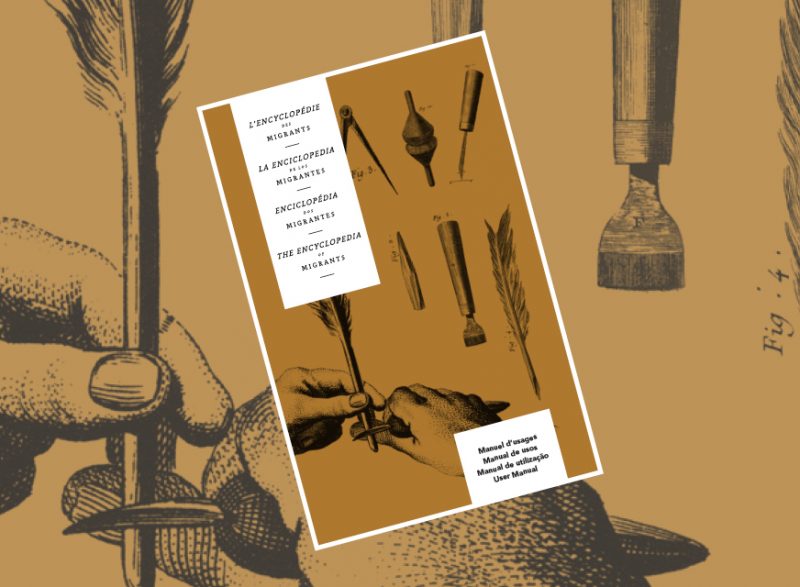
The Encyclopedia of Migrants is an artistic experimentation project initiated by Paloma Fernández Sobrino, in collaboration with a network of 8 cities of the Atlantic side of Europe, including the City of Lisbon.
From 27-30 September 2017, the 25th ENCATC Congress on Cultural Management and Policy will gather together in Brussels (Belgium) academics, researchers, professionals and representatives from various EU institutions, governments and European and international networks to discuss the key role of networks and develop ideas and proposals to guarantee their sustainability in a challenging environment.
Culture Action Europe's annual conference 'Beyond the Obvious - Belonging & Becoming: Culture, Heritage and our Future' will take place from 15-17 November in Rome (Italy). Save the date and register now!
The German Commission for UNESCO, the European Cultural Foundation, Racines and Ettijahat-Independent Culture are inviting you to contribute to their joint online publication that highlights practices and projects from and around the MENA Region, which showcase pathways to cultural diversity. Check out their call for sharing experiences.
Following the success of the first and second Culture Summits, and considering the growing importance of culture in the framework of sustainable cities, the Executive Bureau of UCLG has decided to convene a third UCLG Culture Summit in 2019.
The UCLG Culture Summit is a unique global event, sends very strong messages on the role of culture in development and provides a remarkable international visibility to the city / region / local government that hosts the event. The programme of the Summit, to be elaborated between the UCLG Committee on culture and the host city, will emphize that culture is an integral part of sustainable cities, and will promote the sharing of experiences and innovations from cities accross the world.
We are therefore pleased to invite you to consult the Terms of Reference of the UCLG Culture Summit and to submit candidacies to host the event.
Під час перебування в декреті виникає чимало витрат, які не завжди можна покрити з базового доходу. Молодим мамам складно отримати позику в банках через нестабільний фінансовий статус або відсутність офіційного працевлаштування. Саме тому кредит для декретниць став ефективним рішенням для забезпечення додаткової фінансової підтримки. Оформлення відбувається онлайн, без довідок і складних перевірок. Достатньо лише картки та базових персональних даних. Це зручний спосіб забезпечити себе необхідними коштами в період, коли витрати зростають, а доступ до традиційного кредитування обмежений.
The International Federation of Library Associations and Institutions (IFLA), in partnership with the Technology and Social Change Group at the University of Washington (TASCHA), launched the first Development and Access to Information (DA2I) Report at The New York Public Library, during the United Nations High Level Political Forum (HLPF) on 17 July 2017.
Багато сучасних сервісів впроваджують повну автоматизацію процесу видачі позик, що значно зменшує час очікування та людський фактор. Якщо потрібне швидке рішення без зайвих перевірок, найкращим варіантом стане автоматичний кредит онлайн, де заявку обробляє система за чіткими алгоритмами. Це дозволяє уникнути затримок, пов’язаних із ручною перевіркою, та миттєво отримати результат. Після схвалення кошти надходять на банківську картку без будь-яких додаткових дій. Такий підхід ідеально підходить для тих, хто цінує швидкість, мінімальну взаємодію з оператором та чіткість умов. Автоматизація процесу — це не тільки зручно, а й безпечно для користувача.
© Copyright 2025. All rights reserved.