

Global panel 2015

Culture 21 Actions: Global Panel 2015

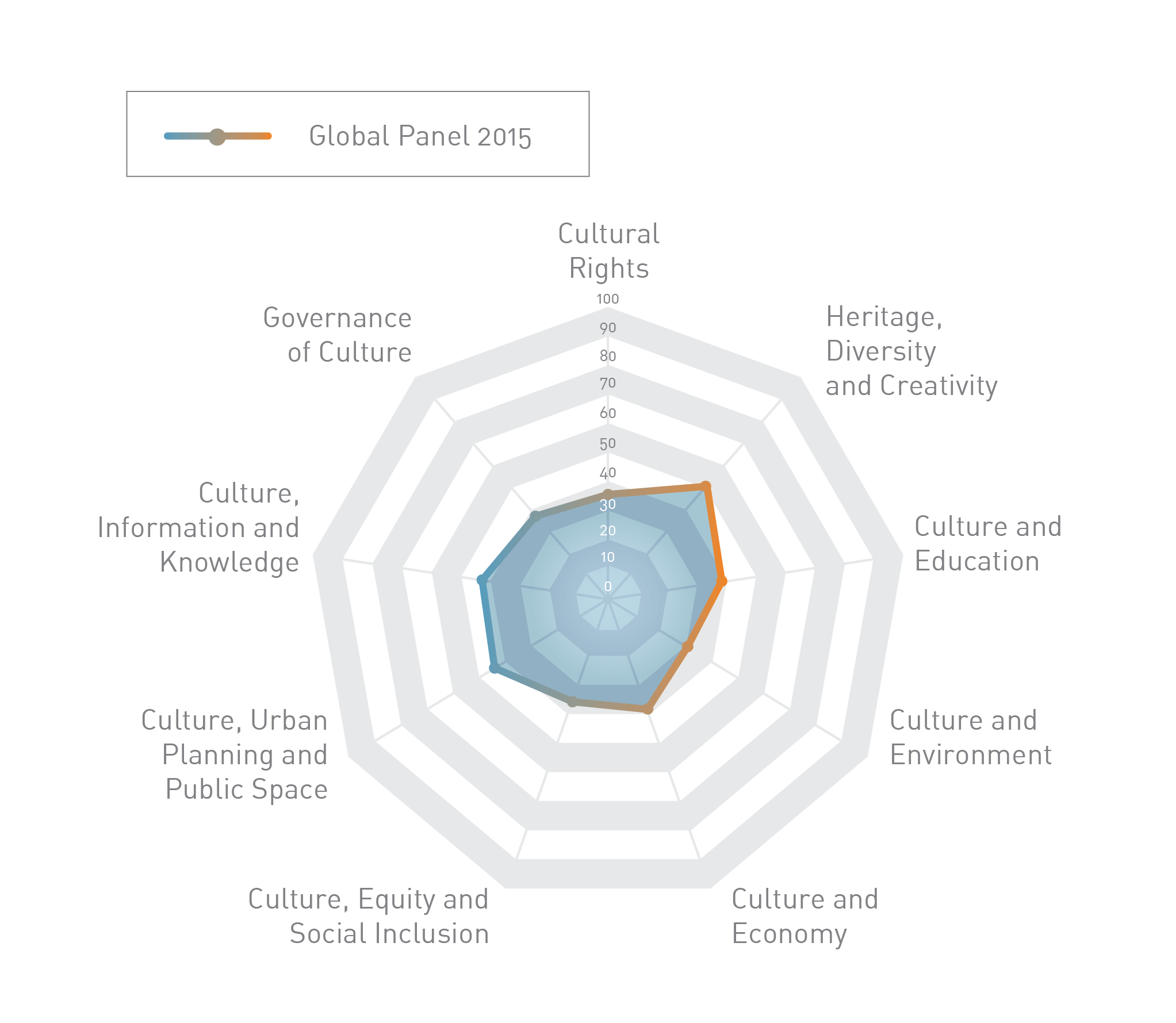
Following the adoption in March 2015 of Culture 21 Actions, the Committee on Culture of UCLG has launched a Global Panel of 34 experts to produce a snapshot of the way in which cities around the world are advancing an integrated vision of culture in sustainable development. Results depict a very interesting landscape, with regional differences as well as varying degrees of development in each of the 9 thematic areas or ‘commitments’ considered in Culture 21 Actions:

Imagen
imatge global panel

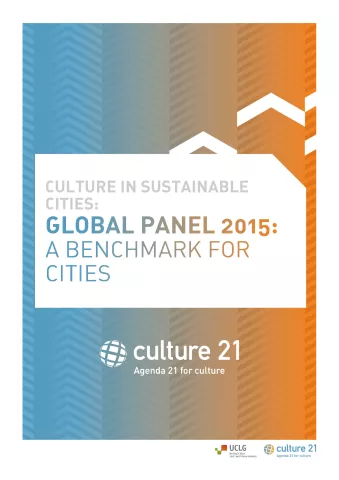
The Secretariat of Committee on Culture of UCLG has elaborated a document with the results of this Global Panel 2015 which includes the list of the experts who contributed to build this benchmark.

The Global Panel 2015 has been elaborated with the answers to an online questionnaire. It can be used by cities and local governments that wish to self-evaluate the place of culture in sustainable development. It is also freely available to researchers, activists and any people committed to culture in sustainable cities. We invite you to use the online questionnaire on culture in sustainable cities. 
Webinars

In the context of the development of our training, peer-learning and capacity-building activities, the Committee on Culture of UCLG has developed an online specific offer aiming at building capacities in local and regional governments interested in deepening their understanding of cultural policies for local sustainable development. This includes webinars and Massive Online Open Courses (MOOCs) on specific issues. Please see below. 

MOOC on Culture and Climate Resilient Development

Imagen
imatge webinars

Building on the report entitled "The Role of Culture in Climate Resilient Development", coordinated by Andrew Potts, coordinator of the Climate Heritage Network, and published in late 2021, the UCLG Committee on Culture have elaborated a MOOC to explore and learn about these issues.

Hosted on the UCLG Learning platform known as #LearningWithUCLG, our MOOC explores the fundamental role of Culture in Climate Resilient Development, and focuses on the perspective of local and regional governments, as well as cultural actors and institutions from all continents. 

The MOOC showcases a wide variety of case studies from all over the world drawn from an open call for contributions for the elaboration of the report, a good practice from UCLG Learning peer-learning notes, and audio-visual resources within the modules, as well as complementary in-depth materials, which you will find at the end of the course. Moreover, it offers the opportunity to test your own knowledge in the field.

What will you learn in this MOOC?

  • How to make arts, culture and heritage take part as key factors for imagining new resilient futures; desirable ways of living neither wedded to the carbon economy nor dependent on unsustainable narratives.
  • How to engage with climate change profiles and vulnerability scenarios.
  • How cultural actors are and should be further involved in the emissions of their communities.
  • How to further engage with interdisciplinary work towards tackling climate change, intertwining cultural actors with a wide range of different sectors.
  • How to identify potential tensions or synergies that may arise between climate action and culture, thus reconciling trade-offs and maximising synergies.
  • How to address the challenges of climate change through a cultural lens and from a perspective of equity and justice.

The MOOC is open to anyone interested in learning on the relation between culture, local public policies and climate resilient development. It is free of charge, available in English, and it includes a completion certificate.

You can access the MOOC at: https://learningwith.uclg.org/p/culture-and-climate

Other webinars

Imagen
imatge other webinars

Building on the extensive experience of working with cities and local and regional governments on the development of cultural policies for local sustainable development throughout the years and through our learning and capacity-building programmes – namely Leading Cities, Pilot Cities, Culture 21 Lab and The Seven Keys, the Committee on Culture of UCLG has developed a series of thematic webinars, including the following:

  • Culture in the Sustainable Development Goals
  • Culture, cities and the COVID19 pandemic
  • Using the Full Potential of Culture in the Local Achievement of the SDGs


All our webinars are facilitated by experts from the Committee through Zoom platform.

They are available in English, French and Spanish upon prior registration on the #LearningWithUCLG dedicated website.

Our webinars are open to local and regional governments, and especially to officials and officers working in teams in charge of Planning, Community Development, Culture, Education, Heritage, Inclusion and Public Spaces.

The UCLG Culture Committee shapes these webinars according to the needs expressed by members. In other words, the webinars can be specifically prepared as a capacity-building activity for a group of key actors working in the same government, or it can be designed as a peer-learning activity involving representatives of several governments.

Imagen
imatge "Culture in the Sustainable Development Goals"

Culture in the Sustainable Development Goals

  • Duration: 1h
  • Description: the webinar "Culture in the Sustainable Development Goals" provides the essential information on the relation between Culture and the 17 Sustainable Development Goals.
  • Full information and registration here.
Imagen
imatge "Culture, cities and the COVID-19 pandemic"

Culture, cities and the COVID-19 pandemic

  • Duration: 1h
  • Description: The webinar "Culture, cities and the COVID-19 pandemic" considers the initial initiatives implemented by cities and local governments, and analyses the impact of the crisis in the cultural life of cities.
  • Full information and registration here.
Imagen
imatge "Using the Full Potential of Culture in the Local Achievement of the SDGs"

Using the Full Potential of Culture in the Local Achievement of the SDGs

  • Duration: 2h
  • Description: The webinar "Using the Full Potential of Culture in the Local Achievement of the Sustainable Development Goals" provides an in-depth information on the relation between Culture and the 17 Sustainable Development Goals.
  • Full information and registration here.

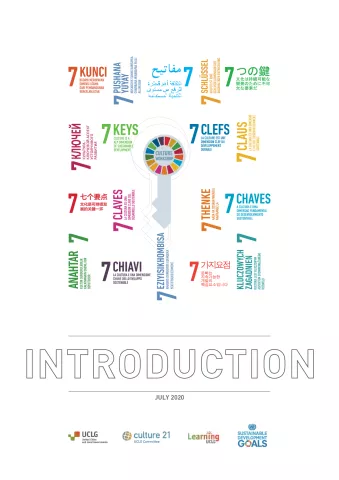
The Seven Keys

Imagen
imatge the seven keys

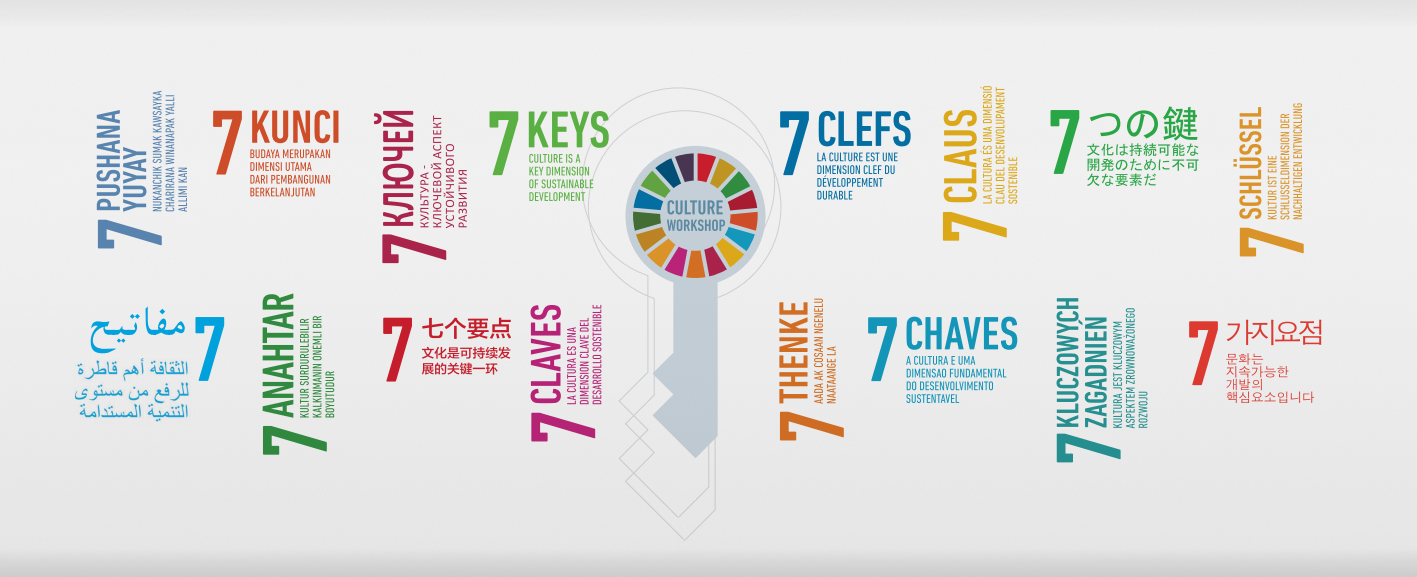
The Seven Keys is a workshop to integrate the cultural dimension in the localisation of the SDGs.

The workshop is designed by UCLG for cities, local and regional governments all around the world.

The workshop related municipal challenges with cultural assets, activities, and policies with the leneses of our Guide for Local Action on Culture in the SDGs. The participants will discuss until reaching seven "keys" that local actors can commit to localize the SDGs through culture policymaking. The most essential and concrete objective of the programme is that the seven keys are locally identified: each city / territory will have their own seven keys.

The Seven Keys is especially suitable for cities, municipalities and regions that are not familiar in analysing the relation between and the implementation of the SDGs with local Cultural Policies. After the workshop, all participants will have a shared understanding of what the SDGs are and how can they be localized from different perspectives, as well as a concrete list of achievable actions that will contribute significantly to the localization of SDGs in their municipalities.

Culture 21 Lab

Culture 21 Lab is a capacity-building programme on culture in sustainable cities.
On the basis of Culture 21 Actions, the Committee on Culture of UCLG has established a short-term programme of capacity-buildingand peer-learning, along with the Leading Cities programme, and the Pilot Cities programme. Culture 21 Lab takes the form of a 1.5-day workshop, involving a group of 12-30 local stakeholders: different ares of local government, civil society actors, academics, private bodies...

You can find here the Terms of Reference of the Culture 21 Lab workshop:

2002-2004

Imagen
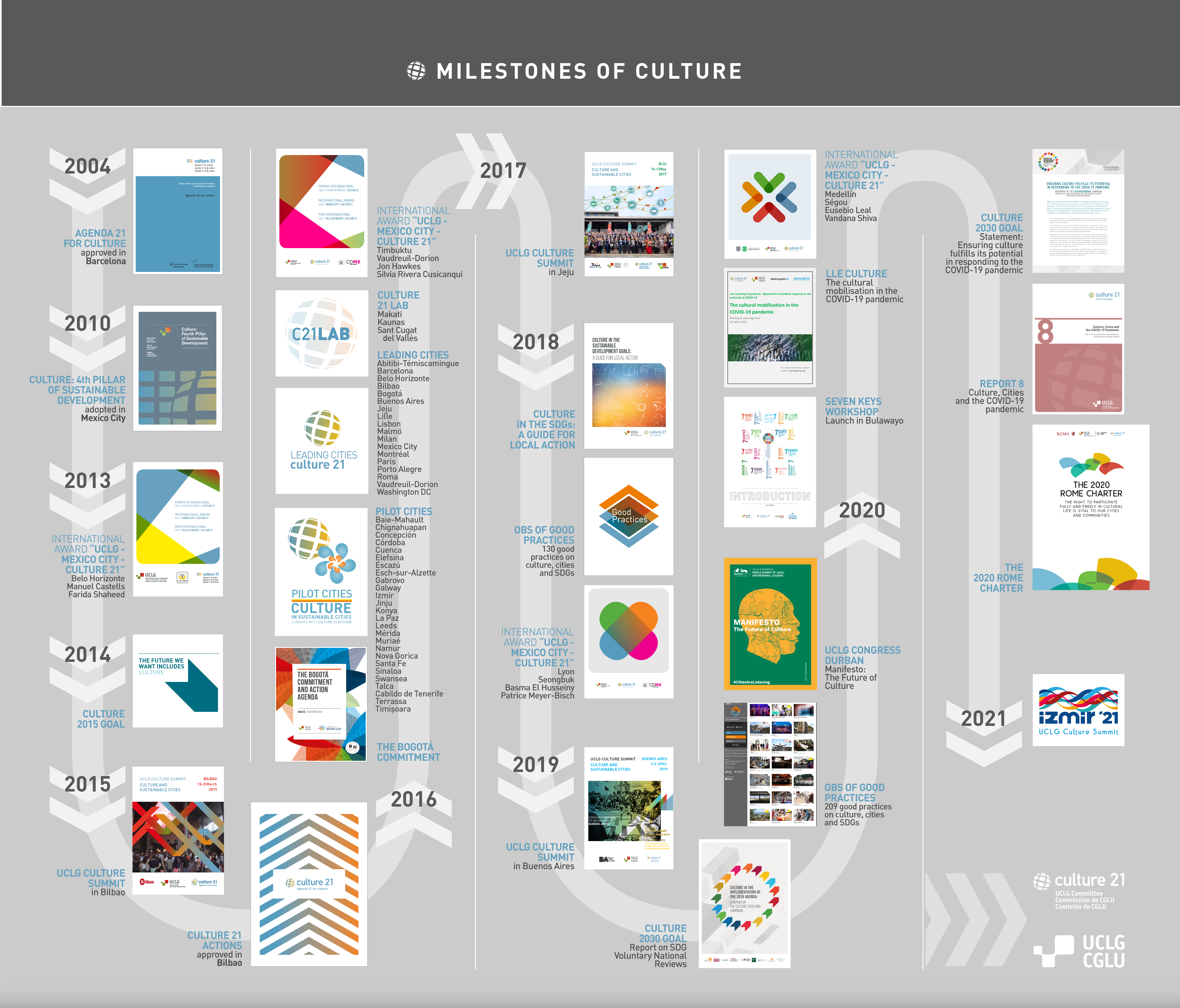
Infografia 2004 2021
Logo 2004

October. UCLG’s World Council in Sao Paulo. The mechanisms needed for the creation of Work Groups are agreed and presented. UCLG officially adopts the Agenda 21 for Culture as a reference document and assumes the coordination of its impulse and dissemination.

September 15th. Presentation of the Agenda 21 for Culture before UCLG, UN-HABITAT and UNESCO.

May 8th. Approval of the Agenda 21 for Culture in the framework of Porto Alegre’s IV Forum of Local Authorities for Social Inclusion, held in Barcelona.

May 5th. United Cities and Local Governments (UCLG) Foundational Congress in Paris. The statutes of UCLG assume the commitment to boost and promote the Agenda 21 for Culture.

January. Presentation of the Agenda 21 for Culture draft in the framework of the Local Authorities for Social Inclusion Forum.

Logo 2003

November. Presentation of the Agenda 21 for Culture draft in the European Forum of Local Authorities held in Saint-Denis.

January.  The elaboration of the Agenda 21 for culture is started in the framework of the III Forum of Local Authorities for Social Inclusion in Porto Alegre

Logo 2002

September. The First World Public Meeting on Culture is held in Porto Alegre. The idea of designing a document that explores the relation between culture and sustainable development arises in this important momentum.

2005-2009

Imagen
Infografia 2004 2021
Logo 2009

November. 4th meeting of UCLG’s Culture Commission held in Guangzhou.

October. Publication of the report “Cities, cultures and developments. A report that marks the fifth anniversary of Agenda 21 for culture”. This study comprises 20 articles presenting the situation of the Agenda 21 for Culture five years after its approval and its perspectives.

September. Release of the report “Culture and sustainable development: examples of institutional innovation and proposal of a new cultural policy profile” commissioned by the UNESCO Division of Cultural Policies and Intercultural Dialogue.

June. Publication of the report “Culture, local governments and Millennium Development Goals”, that aims to explore the links between culture, development strategies and local governments and the central role that culture should play  in those local development strategies targeted at fulfilling the Millennium targets and goals.

Logo 2008

November. 3th meeting of UCLG’s Culture Commission held in Istanbul. Memorandum of Understanding between UCLG and AECID (Spanish Agency for International Development Cooperation).

October. Publication of the report “The Agenda 21 for Culture in France”, developed by Christelle Blouët (Réseau 21).

June. “Culture and strategies for local development” seminal held in Dakar alongside the Dakar municipality, the West Africa Economic and Monetary Union (UEMOA), Senegal’s Culture ministry and the AECID.

March. Seminar “Urban policies and cultural development: planning as a Strategy” in Quito, alongside the Metropolitan Council of Quito, the Inter Local Network of Iberoamerican cities for Culture and the AECID.

Logo 2007

November. The UCLG World Congress is held in Jeju. The Culture Work Group becomes the “Commission of Culture” and receives the mandate to foster and spread the Agenda 21 for Culture. Lille-Métropole joins the governance group as vice-president.

September. 2nd meeting of the Culture Work Group took place in Lille.

Logo 2006

October. 1st meeting of the Culture Work Group in Barcelona. Approval of the following documents: “Advice on local implementation of the Agenda 21 for culture” and “Cultural indicators of the Agenda 21 for Culture”.

September. Presentation of the report “Local policies for Cultural Diversity”, commissioned by the UNESCO Division of Cultural Policies and Intercultural Dialogue.

Logo 2005

June. UCLG’s Executive Bureau held in Beijing. The Culture Work Group is officially created under the mandate of fostering and spreading the Agenda 21 for Culture. This Group is chaired by Barcelona and Buenos Aires and Stockholm are elected as vice presidents.

2010-2014

Imagen
Infografia 2004 2021
Logo 2014

November. The First Edition of our « International UCLG Award – City of MEXICO – Culture 21 » was held. The cities of Belo Horizonte (winner city), Hannover and Ougadougou (special mentions) were awarded whereas Manuel Castells and Farida Shaheed were recognized in category of individuals.

September. Second edition of the Seminar “Cities, Culture, Future” in Buenos Aires. In this context the 11th UCLG’s Commission of Culture meeting took place. Furthermore it was elaborated the final draft of Culture 21 Actions, the document that would eventually be presented as an update of the Agenda 21 for culture.

August. Publication of the following expertise articles as part of the update process of the Agenda 21 for Culture: Paul James, Lucina Jiménez, Alfons Martinell, Eduard Miralles, Patrice Meyer-Bisch, Robert Palmer, Johanne Turbide and Minja Yang.

July. Release of a survey regarding the contents of the Agenda 21 for culture, collecting 255 replies.

June. Publication of the key messages expressed by the Commission leading cities within the ambit of update of Agenda 21 for Culture. These leading cities were: Angers, Barcelona, Bilbao, Lille-Métropole and Montreal.

May. Publication of the first draft of Culture 21 Actions.

Publication of the second advocacy document “Declaration on the inclusion of culture in the sustainable development goals” in the framework of the campaign “The Future that we want includes Culture”, also known as #culture2015goal.

April. The seminar "Towards a New Agenda 21 for Culture: African Cities take the floor" was held in Dakar in the framework of the Agenda 21 for Culture’s update process.

February. Release of the Pilot Cities experimental program. The cities of Belo Horizonte, Bogota, Concepción, Gabrovo, Jeju’s Province, the City of Mexico, Talca and Vaudreuil-Dorion joined the program, framed in the Agenda 21 for Culture’s update process.

Logo 2013

December. Launch of the call for applications for the First Edition of the “International Award UCLG – Mexico City – Culture 21”, targeted at awarding and recognizing leading cities and individuals that have distinguished themselves through their contribution to culture as a key dimension in sustainable cities.

November. The Seminar “Researching cultural sustainability” was held alongside with the COST network in Brussels within the context of the Agenda 21 for Culture’s update process.

October. UCLG’s World Congress was held in Rabat.

September. Publication of the advocacy document “Culture as a Goal in the post-2015 Development Agenda” in the framework of the campaign “The Future that we want includes Culture”, also known as #culture2015goal.

First edition of the Seminar “Cities, Culture, Future” in Buenos Aires.

June. UCLG’s Commission of Culture 10th meeting held in Lille. A process to start elaborating a new document that should result in an update of the Agenda 21 for Culture is approved.

May. UNESCO’s International Congress in Hangzhou: “Culture: Key to Sustainable Development” adopts the Declaration “Placing Culture at the Heart of Sustainable Development Policies”.

Logo 2012

December. UCLG’s Commission of Culture 9th meeting held in Dakar in the framework of UCLG’s World Council.

Publication of the “Rio+20 and the culture: Advocating for Culture as a Pillar of Sustainability” report.

September. UCLG’s Commission of Culture 8th meeting held in Barcelona. Approval of a new governance team, formed by Lille-Métropole (president), Buenos Aires and Mexico City (co-president) and Angers, Montréal and Milan (vice-presidents).

June. Seminar “Culture and Sustainability in Rio+20” in the framework of the UN’s Conference about Sustainable Development (Rio+20).

Logo 2011

December. UCLG’s Commission of Culture 7th meeting held in Florence within the framework of UCLG’s World Council. Agreement for starting a process that enhances the renewal of the Commission governance system.

June. 6th meeting of UCLG’s Commission of Culture in Rabat in the context of UCLG’s Executive Bureau.

Successful call for projects of the Agenda 21 for culture in cooperation with AECID.

Pilot Cities

Based on Culture 21 Actions, and building on the experiences of the 2014, 2015 and 2016 Pilot Cities programme, UCLG's Committee on Culture launched a programme entitled 'Culture in Sustainable Cities. Learning with Culture 21 Actions'. Through this program, cities become "Pilot Cities" of Agenda 21 for culture and participate in a process of learning, capacity building and connectivity, based on the principles and actions of Culture 21 Actions.

Two branches of the programme have been developed: the Global Pilot City programme and the European Pilot City programme:

Leading Cities

Cities with experience that become the leaders in the implementation of our work programme.

Annually, the Leading Cities receive the support of the Secretariat of the Committee in the areas of Cooperation and Learning (technical assistance, capacity-building good practices) and Communication (website, social networks). The Leading Cities are also the representatives of the Committee on culture of UCLG in international meetings and events.

The Terms of Reference (ToR) of the Leading Cities programme are available here:

2015-2019

Imagen
Infografia 2004 2021
2019 logo

December. The "OBS" interactive database reaches 209 good practices.

Participation to the M2C2M programme on local governments and migration.

November. Approval of the Manifest "The Future of Culture".

Organisation of the UCLG World Congress in Durban.

October. Support to the launch of the Climate Heritage Network.

Organisation of the Global Youth Culture Forum in Jeju.

Participation to the “Beyond the Obvious” Conference, organised by Culture Action Europe in Konstanz y Kreuzlingen.

Cooperation agreement with Les Arts et la Ville and the Cultural Development Network.

September. Publication of the #culture2030goal report on cultural contents of the HLPF.

June. Organisation of a Seminar in the context of the European Development Days.

May. Participation in the Global SDG Festival of Action in Bonn.

April. Third UCLG Culture Summit in Buenos Aires

Celebration of the 16th meeting of the UCLG Committee on Culture.

January. Launch of the second call of "Culture at Work Africa" dedicated to cultural projects in 15 African countries.

Logo 2018

December. Publication of Culture 21 Review.

Report "Cultural heritage and sustainable development. Key themes and examples in European cities", elaborated by Jordi Baltà Portolés.

November. The Global Youth Culture Forum is held in the island of Jeju

October. Participation in "Beyond the Obvious" conference organized by Culture Action Europe in Timisoara. Meeting with the European Pilot Cities.

Third edition of the "International UCLG Award - City of Mexico - Culture 21", recognizing Lyon and Seongbuk (winning cities), Dublin, Hamilton, Montevideo, Nablus, Novosibirsk and Saha-gu (special mentions). Basma ElHusseiny and Patrice Meyer-Bisch were awarded in the category individuals. On the other hand the "Cultural Rights and Peace in the City" seminar was held in the framework of UCLG's Culture Committee 15th meeting.

Presentation of the international report regarding the "Creation of synergies between culture and tourism for permanent and temporary residents" in the context of the "Barcelona Oberta" biennial.

July. Celebration of the UN's High Level Political Forum, targeted at following up the development of the SDGs. Presentation of the report "Towards the localization of the SDGs" report, that encompasses a chapter devoted to cultural issues and factors. Symposium and declaration "Heritage for Sustainability".

June. Creation of the interactive database "OBS", developed to compile multiple good cultural practices and index then into 3 different criteria: the 17 SDGs, the 9 Commitments of Culture 21 Actions, and 75 keywords.

Celebration of a seminar in the framework of the European Development Days and release of the manifest "Reinforcing the synergies between gender issues and culture in the development and the international cooperation".

May. Publication of the document "Culture in the Sustainable Development Goals. A Guide for Local Action".

April. Launch of the first call of "Culture at Work Africa" aiming to support and promote cultural projects in 15 African countries.

March. Publication of the Geneva Declaration: "Human Rights and Cultural Heritage: Committed Cities working together"

February. World Urban Forum (WUF9) held in Kuala Lumpur.

Logo 2017

December. Inaugural sessions of the UCLG Policy Councils on the occasion of the World Council of UCLG in Hangzhou.

November. Participation in the conference “Beyond the Obvious”, organized by Culture Action Europe and held in Rome.

September. Participation in the work of the "Unesco Urban Network" on cultural indicators.

Seminar “Creative Movilities”, held in Grenoble.

July. Participation in the General Conference of UCCI in Lisbon.

June. Celebration of a seminar organized in the context of the European Development Days.

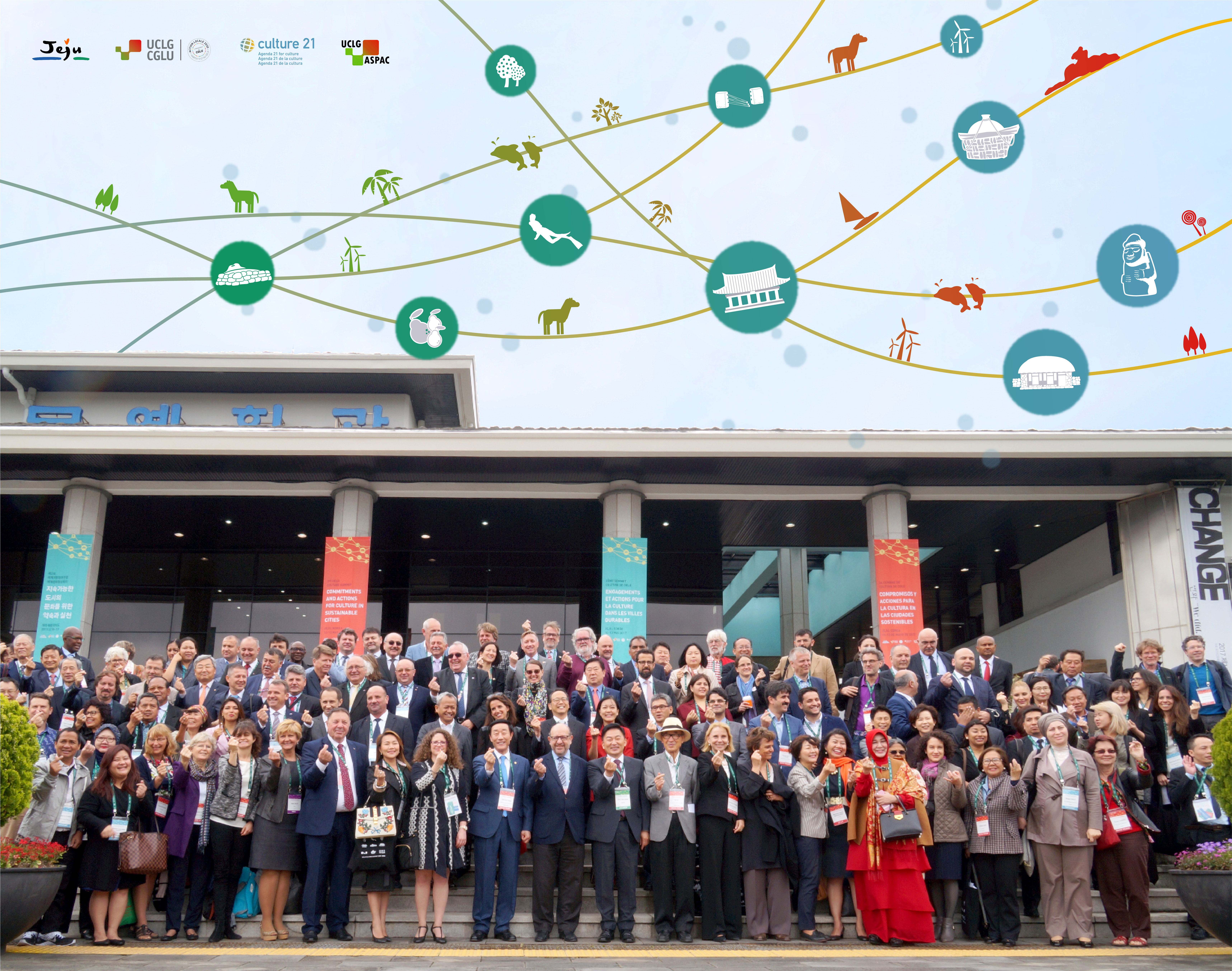
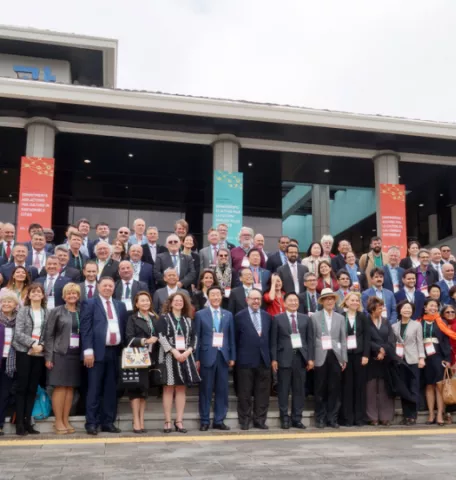
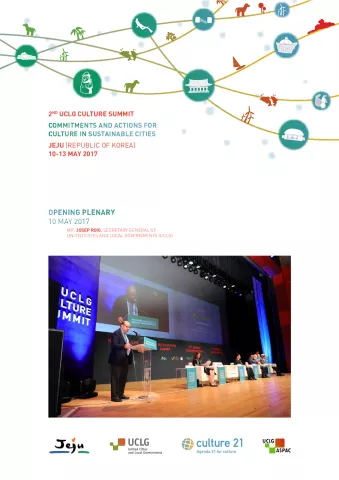
May. Second UCLG Culture Summit held in Jeju.

Celebration of the Culture Commission’s 14th meeting.

April. First Culture 21 Lab driven in Makati.

January. Participation in Beyond the obvious conference celebrated by Culture Action Europe and held in Budapest. Meeting of the European Pilot Cities.

Participation in the work of the "Unesco Urban Network" on post-Habitat 3 and the New Urban Agenda.

Logo 2016

December. Publication of the “Culture, climate change and sustainable development” briefing.

November. Celebration of the Second Edition of the “International UCLG Award - City of MEXICO - Culture 21”, awarding Tomboctou and Vaudreuil-Dorion as winning cities. Busan, Dakar, Kaunas, Lac Mégantic and Montevideu received a special mention whereas Jon Hawkes and Silvia Rivera Cusicanqui were awarded in the individual category.

October. The UN approves the New Urban Agenda.

The UN organizes the Second World Assembly of Local and Regional Governments, organized by the Global Taskforce of Local and Regional Governments in the framework of Habitat III, that aims to “integrate culture as the 4th pillar of sustainable development”.

UCLG World Congress held in Bogota, and approval of the Bogota Commitment and the Action Agenda, that includes commitment 8 targeted at “Fostering heritage, creativity and local diversity through cultural policies focused on people”.

September. New call for Pilot Cities programmes: “Culture in Sustainable Cities: Learning with Culture 21 Actions”. The cities of Baie-Mahault, Elefsina, Esch-sur-Alzette, La Paz, Leeds, Nova Gorica, and the cabildos of Tenerife and Santa Fe join the program.

July. Publication of the positioning document about “Sustainable urban development and culture. Comments regarding the New Urban Agenda’s ’zero draft’ of the New Urban Agenda” in the framework of the Habitat III preparatory works. 

June. Release of the “Culture, Cities and Identity in Europe” report commissioned by the CESE (European Economic and Social Committee of the European Union).

May. Launch of the Leading Cities programme.

January. Publication of the article "Why must culture be at the heart of sustainable urban development" in the framework of the Habitat III preparation works.

Logo 2015

December. Celebration of UCLG’s World Council In Paris alongside the UCLG’s Commission of Culture 13th meeting. A governance team formed by the City of Mexico, Buenos Aires (co-presidency), Angers, Barcelona, Milan, Belo Horizonte, Bilbao, Bogotá, Jeju, Paris and Porto Alegre (vice-president) was approved.

Participation in the ArtCop21 seminar in the context of COP 21.

Participation in the “Beyond the Obvious” conference, organized by Culture Action Europe in Gothenburg. Meeting of the European pilot cities.

November. Publication of the briefing about “Cities, refugees and culture”.

September. Release of the 4th and last influence document “Culture in the SDG Outcome Document: Progress made, but important steps remain ahead” in the context of the campaign “The Future We Want Includes Culture”, also known as “#culture2015goal”.

The UN approved the 2030 Agenda -“Transforming our World”- that encompasses the 17 goals for the sustainable development.

August. Release of the 1st World Panel results regarding the integration of culture in the sustainable development of the cities, following the path of Culture 21 Actions.

June. Set in motion of the “Culture in the Sustainable Cities: Learning with Culture 21 Actions” program, also known as Pilot Cities 2015 Global and Pilot Cities Europe 2015. This last program was created by partnering up with Culture Action Europe. The cities that joined this program were: Chignahuapan, Concepción, Cuenca, Escazú, Gabrovo, Galway, Izmir, konya, Lisboa, Mérida, Namur, Sinaloa, Swansea, Terrassa and Timisoara.

March. Publication of the article: “Operationalizing culture in the sustainable development of cities”, in the framework of the Habitat III preparatory works.

The First UCLG Culture Summit was held in Bilbao. Adoption of Culture 21 Actions and celebration of the 12th UCLG’s Commission of Culture meeting.

Publication of the third advocacy document “Proposal of potential indicators about culture in the SDGs” within the ambit of the campaign “The Future that we want includes Culture”, also known as #culture2015goal

SHARE